1 Year Warranty

Description
Technical Specifications
| Parameter | Specification |
|---|---|
| Model | 5466-5025 |
| Manufacturer | Woodward |
| Product family | MicroNet / MicroNet-Plus |
| Module type | High-density analog I/O |
| Analog inputs | 24 |
| Input signal types | Selectable 4–20 mA or 0–5 V |
| Analog outputs | 8 |
| Output signal | 4–20 mA |
| Maximum output load | 600 Ω, including wiring resistance |
| Output resolution | 14 bits |
| Output update time | 5 ms |
| Output accuracy | Software-calibrated to 0.2% of 0–25 mA full scale |
| Isolation | 500 Vrms to earth ground and control common; no isolation between channels |
| Required connections | Two compatible high-density analog/discrete cables to field termination modules |
| Software requirement | MicroNet-Plus MN1.00 or later; TMR TMR1.00-1 or later |
Product Overview
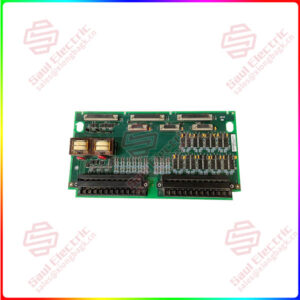
The Woodward 5466-5025 is a high-density analog input/output module for compatible MicroNet control systems. It combines 24 analog input channels with eight analog current outputs on a single module, allowing the controller to acquire process measurements and send continuous control signals through the appropriate field termination hardware. Its input channels can be configured for either 4–20 mA current signals or 0–5 V voltage signals, making it suitable for installations with mixed analog instrumentation requirements.
The module’s output section provides eight 4–20 mA channels, with a maximum specified load resistance of 600 Ω including wiring resistance. Woodward documents a 5 ms output update time and 14-bit output resolution. The outputs are galvanically isolated from earth ground and control common, but not from one another. That distinction matters when reviewing grounding, common-mode voltage, and signal wiring in electrically noisy control cabinets.
The 5466-5025 was introduced as an enhanced option in the MicroNet high-density analog I/O family. Woodward identifies it as a replacement for the earlier 5503-904, but the upgrade requires compatible application software. The manufacturer specifies MicroNet-Plus Coder MN1.00 or later and MicroNet TMR Coder TMR1.00-1 or later. Older systems should not be upgraded by swapping the hardware alone; confirm the controller CPU generation, Coder version, field termination modules, cables, and application configuration first.
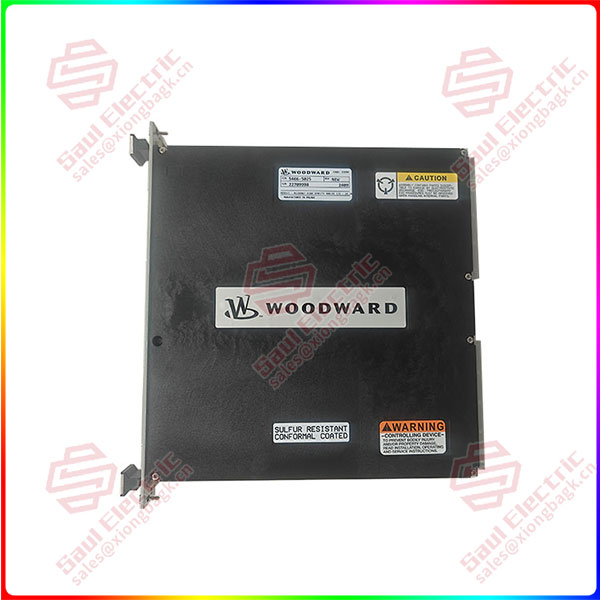
5466-5025
Major Features and Advantages
1. High channel density
The combination of 24 analog inputs and eight analog outputs consolidates measurement and control-signal handling within one module. This can reduce the number of individual I/O cards required in a compatible MicroNet chassis. Actual cabinet-space savings depend on the complete system layout, termination hardware, and cable routing.
2. Selectable input signal types
The 24 input channels support 4–20 mA or 0–5 V signals. This selection gives engineers flexibility when connecting transmitters and voltage-output instruments. Each channel must be configured correctly in the application and matched to its field wiring. A current-loop device should not be connected as though it were a voltage input, or vice versa.
3. Defined analog output performance
The eight output channels provide 4–20 mA signals with a maximum load resistance of 600 Ω, a 5 ms update time, and 14-bit resolution. Woodward specifies output accuracy of 0.2% of the 0–25 mA full scale after software calibration. These ratings provide a useful basis for loop design and acceptance testing, but do not replace checks of field-device requirements, wiring resistance, and actual calibrated performance.
4. Isolation characteristics
The module provides 500 Vrms galvanic isolation between the I/O circuitry and earth ground/control common. There is no galvanic isolation between individual channels. Engineers should account for this when connecting devices with different ground references or when troubleshooting noise and measurement offsets. Isolation must not be interpreted as permission to exceed the manufacturer’s specified electrical limits.
5. Integration with MicroNet control systems
The 5466-5025 uses two compatible high-density analog/discrete cables to connect to the required field termination modules (FTMs). The termination hardware and application channel mapping must agree; correct card installation alone does not ensure that field channel 1, for example, corresponds to the expected control-system point.
Applications
The Woodward 5466-5025 is intended for compatible MicroNet control applications that need a relatively high number of analog measurement and output channels. In turbine control cabinets, analog inputs may be used for supported pressure, temperature, position, or other process transmitters, while the 4–20 mA outputs can drive compatible receiving devices such as valve-positioning interfaces or other control equipment. The actual signal assignments are determined by the application and plant design.
In compressor and prime-mover control systems, the module can consolidate analog signals from instrumentation distributed around the machinery package. Its selectable input types can be useful when the installed instrument population includes both current-loop transmitters and voltage-output sensors or signal conditioners. Each instrument’s output range, loop-power arrangement, common reference, and wiring must be checked before connection.
The module may also be used in MicroNet TMR configurations where the control architecture and software support it. TMR installation requirements differ from simplex arrangements, so engineers must verify the approved module configuration, termination hardware, cable routing, and application mapping. Do not infer TMR suitability merely from the module’s use in the broader MicroNet family.
For retrofit projects, the 5466-5025 is particularly relevant when replacing the earlier 5503-904. Woodward identifies that replacement path but specifies a Coder update for the enhanced module. Before approving the change, verify the installed CPU generation and software version, and plan application testing for every affected analog input and output. A successful chassis power-up is not enough to prove that signal scaling, channel assignments, or closed-loop behavior remain correct.
Related Products
| Model | Relationship to 5466-5025 |
|---|---|
| 5503-904 | Earlier high-density analog I/O module identified by Woodward as replaceable by the 5466-5025, subject to the required Coder update. |
| 5466-5026 | Backward-compatible simplex variant with 24 fixed 4–20 mA inputs and eight 4–20 mA outputs. |
| 5466-5027 | Backward-compatible variant with 24 fixed 0–5 V inputs and eight 4–20 mA outputs, for specified TMR and Dataforth configurations. |
| 5466-315 | Earlier module for which Woodward lists the 5466-5026 as a possible replacement, subject to application-specific filter requirements. |
| 5466-332 | Earlier 24-input analog module associated with the 5466-5026 replacement path. |
| 5466-425 | Earlier voltage-input module associated with the 5466-5027 replacement path. |
| 5501-376 | High-density analog/discrete cable option listed for simplex applications. |
| 5501-372 | Cable option listed for MicroNet TMR applications. |
Installation and Maintenance
Before installing the Woodward 5466-5025, verify the part number, controller type, Coder version, chassis compatibility, and required termination hardware. Woodward specifies MicroNet-Plus Coder MN1.00 or later and MicroNet TMR Coder TMR1.00-1 or later. If the existing application uses an older version, resolve the software and migration requirements before replacing the hardware.
Isolate the control system according to the approved site procedure. Inspect the card guides, backplane connector, cable connectors, and termination modules for contamination, corrosion, damaged contacts, or signs of overheating. Connect the two required high-density analog/discrete cables to the correct termination assemblies, then verify that the field wiring and software channel assignments match the drawings.
During commissioning, check each input against a known signal and verify the configured input type and scaling. For outputs, test representative 4–20 mA commands with an appropriate measurement instrument and load. Confirm that the total load, including cable resistance, remains within the 600 Ω limit. Verify alarm behavior and application response before returning the control loop to service.
If readings are unstable or incorrect, check the selected input type, loop wiring, common reference, channel mapping, grounding, and electrical noise before concluding that the module is faulty. Record test values and configuration changes so future maintenance personnel can distinguish hardware faults from wiring or software problems.
Product Assurance
For procurement, confirm that the supplied module is marked 5466-5025 and request photographs of its label, revision, connectors, and physical condition. Ask the supplier to identify whether the unit is new, used, refurbished, or repaired. Do not assume a product’s condition from its listing description alone.
For used or refurbished stock, request a written test report covering startup diagnostics, analog input verification, output-current checks, and any calibration work performed. A visual inspection or basic power-up test does not establish that all 32 channels meet their specified performance. Confirm the scope of testing and whether test results are traceable to the supplied serial number.
Before approving a replacement, verify Coder compatibility, the exact FTM and cable arrangement, and the intended simplex or TMR configuration. Where the 5466-5025 is replacing a 5503-904 or another legacy module, treat the work as an engineering change that requires software review and signal-level acceptance testing.
Procurement recommendation: The Woodward 5466-5025 is a 24-input, eight-output high-density analog I/O module. Prioritize correct software compatibility, verified termination hardware, and documented channel testing rather than relying solely on a matching part number.