1 Year Warranty

Description
Technical Specifications
| Parameter | Specification |
|---|---|
| Model | 5466-1035 |
| Manufacturer | Woodward |
| Product family | MicroNet-Plus |
| CPU family | CPU5200 |
| Processor | Motorola PowerPC MPC5200 |
| Memory | 128 MB DDR RAM reported by product listings; confirm revision |
| Network interface | 10/100 Mbps Ethernet reported |
| Real-time clock | Yes |
| Operating configuration | Simplex or redundant, depending on system architecture |
| Chassis | Compatible MicroNet-Plus chassis; confirm exact chassis and slot |
| Operating temperature | Published listings report 0°C to 55°C; verify the official hardware manual |
| Firmware / application compatibility | Coder 4.06 through 5.04, according to Woodward’s product-change notice |
| Lifecycle designation | Non-preferred |
Important compatibility note: The 5466-1035 is an earlier CPU5200 version. Woodward’s documentation states that CPU part numbers changed as FPGA code and firmware evolved, and that the required CPU depends on the application’s Coder version. Do not select a replacement by physical appearance or family name alone.
Product Overview
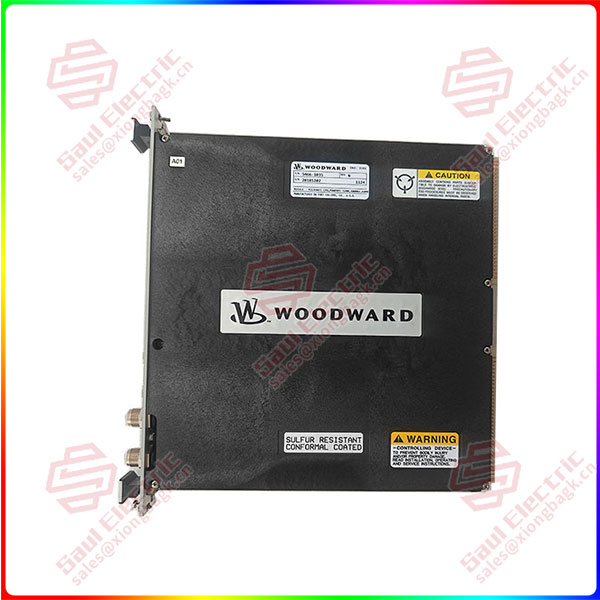
The Woodward 5466-1035 is a CPU5200 processor module used in the MicroNet-Plus digital control platform. It serves as the controller’s processing unit, executing the application logic used to govern and monitor industrial machinery. MicroNet systems are used in turbine and other prime-mover control applications, where predictable control execution and correct interaction with the installed I/O hardware are essential. The module is not a general-purpose PLC CPU; it must be evaluated within the specific Woodward control architecture for which it was configured.
The 5466-1035 uses a Motorola PowerPC MPC5200 processor and includes Ethernet connectivity and a real-time clock, according to published product information. It can be deployed in simplex or redundant configurations when supported by the system design. However, its expansion-chassis capabilities and network functions must not be assumed from the presence of an Ethernet port. Product listings report that this version lacks the Real-Time Network (RTN) ports needed for expansion-chassis operation. Confirm the original chassis configuration and communication requirements before ordering a replacement.
The most significant consideration is firmware and application compatibility. Woodward’s Product Change Notification 06960 identifies the 5466-1035 for MicroNet-Plus Coder versions 4.06 through 5.04 and classifies it as non-preferred. Later CPU variants support different software generations and may introduce cybersecurity functions absent from this model. For a plant maintaining an established controller, matching the existing hardware and software baseline is often the first requirement; for a broader modernization, the complete upgrade path should be assessed rather than replacing the CPU in isolation.
5466-1035
Major Features and Advantages
1. Dedicated real-time processing
The MPC5200 processor provides the computational platform for executing the installed control application. In turbine control, the CPU’s role includes processing application logic and coordinating data exchange with configured I/O modules. Actual scan timing and control response depend on the application, firmware, task configuration, and connected hardware—not just the processor specification.
2. Ethernet connectivity and clock functions
The module includes Ethernet connectivity and a real-time clock, according to published specifications. These functions support applicable engineering, diagnostic, and system-time requirements. Before connecting the module to a plant network, identify the active port functions and the approved network architecture. The presence of Ethernet does not mean that all modern security controls are available.
3. Simplex and redundant system configurations
The 5466-1035 is reported for simplex and redundant MicroNet configurations. In a redundant arrangement, the companion CPU, chassis configuration, application synchronization, and failure response must all be compatible. A spare that passes a basic power-up test may still fail to take over correctly if its software or configuration differs from the running controller.
4. Established-system maintenance
For an operating MicroNet-Plus installation, retaining a compatible CPU5200 may reduce the immediate scope of a maintenance intervention. This benefit depends on having a verified spare, the correct application software, and a documented recovery procedure. Record the original module’s part number, revision, configuration, and fault history before replacement.
5. Lifecycle and cybersecurity limitations
Woodward classifies this model as non-preferred for new systems. Its cybersecurity documentation also states that the 5466-1035 does not meet the listed requirements for secure passwords, Achilles certification, SSH/firewall functionality, or SecureApp support. These limitations matter when assessing network exposure and modernization requirements. A hardware replacement alone does not establish cybersecurity compliance; the complete controller, network, and operating procedures must be reviewed.
Applications
The Woodward 5466-1035 is primarily relevant to existing MicroNet-Plus control installations that use the CPU5200 platform. Typical application environments include turbine control systems and associated industrial machinery where the controller executes a site-specific application. The exact machinery, control strategy, and I/O arrangement depend on the original project configuration.
In a turbine control cabinet, the CPU processes the application logic responsible for coordinating inputs, operating commands, alarms, and control outputs through the installed system architecture. A processor replacement can affect more than basic startup: the application version, Coder compatibility, module configuration, and communication paths must all be checked. If a replacement CPU is not compatible with the installed application, the controller may not start the expected project or may fail to communicate with other system components.
The 5466-1035 may also be encountered in redundant control systems. In these installations, replacement planning should include the role of each CPU, the required synchronization behavior, the approved transfer procedure, and the consequences of a failed switchover. Do not assume that a spare configured for a simplex installation can be inserted directly into a redundant system without engineering checks.
For plants reviewing older control hardware, cybersecurity is another important application consideration. Woodward’s documentation identifies limitations in the security capabilities of this CPU generation. Where the controller remains in service, network segmentation, restricted engineering access, and site-specific security controls should be evaluated. Where modernization is being considered, select a successor only after reviewing application compatibility, hardware requirements, and the manufacturer’s documented migration path.
Related Products
| Model | Relationship |
|---|---|
| 5466-1036 | Related Remote Transceiver (RTN) module listed by Woodward as the return/replacement part number for the 5466-1035 family. It is not a CPU substitute. |
| 5466-1045 | Later MicroNet-Plus CPU5200 variant with a different Coder compatibility range and cybersecurity features. |
| 5466-1047 | CPU5200 variant for MicroNet TMR and certain 5009 applications; not automatically interchangeable with the 5466-1035. |
| 5466-1145 | MicroNet-Plus CPU variant for newer software generations, with documented cybersecurity capabilities. |
| 5466-1245 | MicroNet-Plus CPU variant supporting later Coder versions; confirm application requirements before substitution. |
| 5466-1511 | Preferred MicroNet-Plus CPU option in Woodward’s cybersecurity manual; modernization compatibility still requires review. |
| 5466-1521 | Preferred MicroNet-Plus CPU option with SecureApp functionality documented by Woodward. |
Installation and Maintenance
Before replacing the Woodward 5466-1035, record the running controller’s part number, hardware revision, installed Coder/application version, chassis layout, and any available configuration backup. Confirm that the spare is intended for the same MicroNet-Plus configuration. Because Woodward documents changes in FPGA code and firmware across CPU part numbers, a visually similar module should not be assumed compatible.
Follow the approved shutdown and isolation procedure for the installed control system. Do not remove or insert the module under power unless the applicable manual explicitly permits it for that chassis and configuration. Inspect the module’s connectors and seating position, and check for signs of contamination, corrosion, or physical damage.
After installation, follow the site’s commissioning procedure. Verify the expected status indicators, controller startup, application execution, communication with required modules, and alarm behavior. In a redundant system, confirm that the standby CPU is recognized and that the approved redundancy checks pass. Do not perform an uncontrolled transfer test on an operating machine.
If the CPU fails to initialize or the application does not run correctly, investigate the software baseline, module configuration, chassis compatibility, and communication path before assuming the replacement hardware is defective. Preserve the original module and configuration records until the system has passed its acceptance checks.
Product Assurance
For procurement, confirm that the unit is labeled 5466-1035 and request clear photographs of its nameplate, hardware revision, and connectors. Ask the supplier to state whether the item is new, used, refurbished, or repaired; that condition should not be inferred from the listing title alone.
For used or refurbished units, request a written test report that covers startup, diagnostic status, and any available functional testing. A simple power-on test does not establish compatibility with a specific application or prove successful redundant operation. Confirm what was tested and whether the original configuration is included.
Before accepting a replacement, verify the supported Coder range, required chassis configuration, and communication needs against the installed system. Given the model’s non-preferred lifecycle status and documented cybersecurity limitations, also determine whether the purchase is intended for like-for-like maintenance or part of a broader control-system upgrade.
Procurement recommendation: The Woodward 5466-1035 is best evaluated as a legacy MicroNet-Plus CPU5200 spare. Prioritize exact part-number and software compatibility, and obtain engineering approval before substituting a later CPU model.