1 Year Warranty

Description
Technical Specifications
| Parameter | Specification |
|---|---|
| Model | 396879-11-0 |
| Manufacturer | Emerson / Bristol Babcock |
| Product family | ControlWave Micro |
| Module type | CPU / central processing unit |
| Processor speed | 150 MHz |
| Flash memory | 16 MB |
| SDRAM | 64 MB, as documented in Emerson procurement material |
| Ethernet | Two Ethernet ports reported in reseller listings; verify exact hardware configuration |
| Serial interfaces | One RS-232 and one RS-485, according to Emerson procurement material |
| Current consumption | 240 mA reported in product listings; measurement conditions not independently confirmed |
| Replacement reference | 396879-01-2 is identified in reseller listings; confirm interchangeability for the installed controller |
| Operating temperature | Verify against the exact hardware revision and controller documentation |
| Product status | Reported discontinued; current service and spare availability require confirmation |
Product Overview
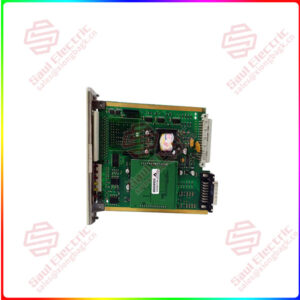
The Emerson Bristol Babcock 396879-11-0 is a central processing unit module associated with the ControlWave Micro remote automation controller family. It provides the processing platform for executing configured control logic, handling data, and coordinating communications with field instrumentation and supervisory systems. ControlWave Micro controllers are used in remote monitoring and control applications across industries such as oil and gas, water and wastewater, pipeline operations, and energy infrastructure.
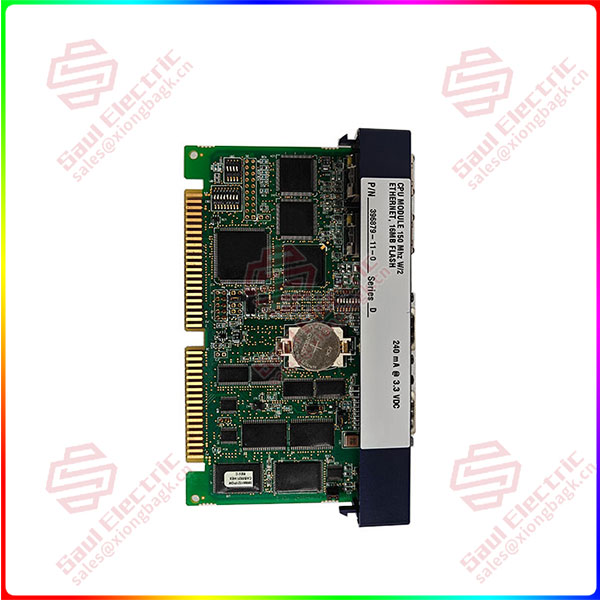
The module is specified with a 150 MHz processor, 64 MB SDRAM, and 16 MB flash memory in an Emerson procurement document. Published product listings also identify a 240 mA current figure and two Ethernet ports, although interface descriptions vary across records. The ControlWave Micro platform was offered in multiple CPU configurations, with different combinations of Ethernet and serial ports. Buyers should therefore verify the actual connector layout and hardware revision rather than assuming every unit carrying this model number has an identical interface configuration.
396879-11-0
For maintenance teams, the important distinction is between replacing the CPU hardware and restoring a working controller. The replacement must match the installed ControlWave Micro configuration, application software, communication settings, and field wiring. A CPU can power up successfully yet remain unsuitable if its configuration does not support the existing network or serial interfaces. The 396879-11-0 is also listed as discontinued by resellers, making condition verification, traceability, and confirmation of an approved replacement especially important for long-running installations.
Major Features and Advantages
1. Dedicated controller processing
The 396879-11-0 serves as the main processing module in a compatible ControlWave Micro system. It runs the configured control application and handles the data processing needed for remote automation tasks. Actual control-cycle performance depends on application design, firmware, configured I/O, and communication load; the 150 MHz processor rating alone does not establish a specific scan time.
2. Memory for application and operating data
The documented configuration includes 64 MB SDRAM and 16 MB flash memory. These resources support controller execution and stored program data, subject to the operating system and application requirements. Before replacing a CPU, verify that the existing project can be restored to the replacement hardware and that the correct application files and configuration records are available.
3. Ethernet and serial communication options
ControlWave Micro CPUs were manufactured with different combinations of Ethernet and serial ports. The platform documentation describes optional 10/100Base-T Ethernet and RS-232/RS-485 serial communications, but the exact arrangement depends on the CPU variant. Confirm the number of ports and their functions on the actual 396879-11-0 before planning network connections or ordering cables.
4. Remote automation integration
The ControlWave Micro family supports industrial communication and remote-control applications. Depending on the software configuration, the platform documentation identifies protocols including BSAP, Modbus, DNP3, and other supported communication options. Protocol availability must be checked against the installed firmware, application, and interface configuration rather than inferred from the CPU model alone.
5. Legacy-system maintenance
For facilities maintaining existing ControlWave Micro equipment, a compatible replacement CPU can help avoid a broader controller redesign during a repair. The trade-off is the limited availability of older hardware and the possibility that replacement stock has a different service history. Confirm the unit’s condition, configuration requirements, and replacement approval before committing to a maintenance window.
Applications
The Emerson Bristol Babcock 396879-11-0 is relevant to ControlWave Micro remote automation installations where the existing controller configuration calls for this CPU. Common platform-level applications include pipeline monitoring, remote pump stations, water-treatment facilities, and distributed process control. The CPU executes the configured control logic; the precise application depends on the project and associated I/O modules.
In pipeline and oil-and-gas installations, a remote controller may acquire pressure, temperature, flow, and equipment-status signals, execute configured logic, and communicate operating data to a supervisory control system. The CPU’s interface configuration matters because field instruments, local serial devices, and Ethernet networks may depend on specific ports and settings. A replacement should retain the required communication path and application behavior.
Water and wastewater facilities may use ControlWave Micro systems for pump control, reservoir monitoring, level management, and remote alarms. When replacing a CPU, technicians should check the application backup, I/O mapping, serial settings, network addresses, and any configured communication protocols. Incorrect restoration can lead to missing telemetry or unexpected control behavior even if the controller appears to start normally.
The module may also be used in other remote industrial installations where the ControlWave Micro platform is already deployed. For these sites, procurement should focus on matching the original part number and interface configuration, confirming the available project files, and planning a controlled return-to-service test. If the original module is unavailable, assess the proposed substitute against the controller documentation and project configuration rather than treating a similar CPU as automatically interchangeable.
Related Products
| Model | Relationship to 396879-11-0 |
|---|---|
| 396879-01-2 | Identified in reseller records as a replaced or superseded part number; verify the exact hardware and application compatibility before substitution. |
| 396879-11-0S | Related ordering variant listed in procurement material; confirm the meaning of the suffix and the required configuration. |
| 396879110-CE | CE-approved assembly designation listed in procurement documentation; confirm certification and assembly requirements for the intended installation. |
| 396563-16-3 | Another 150 MHz ControlWave Micro CPU configuration with different serial-port arrangements. |
| 396563-15-5 | Related 150 MHz ControlWave Micro CPU variant; interface configuration differs. |
| 396563-18-0 | ControlWave Micro communications-oriented CPU variant; not an automatic replacement for the 396879-11-0. |
| 396657-01-0 | ControlWave Micro CPU-related documentation reference; verify the actual hardware designation before treating it as a replacement. |
Installation and Maintenance
Before replacing the Emerson 396879-11-0, record the controller model, CPU part number, hardware revision, application version, communication settings, and I/O configuration. Save the existing project and configuration using the approved tools and procedures. Confirm the exact Ethernet and serial interfaces required by the installation before disconnecting cables.
Isolate power in accordance with site electrical-safety procedures and the applicable ControlWave Micro manual. Use appropriate electrostatic-discharge precautions when handling the circuit board. Inspect the connectors, backplane, and module for contamination, corrosion, damaged contacts, or signs of overheating. Never assume that a replacement CPU is compatible solely because it fits the same controller housing.
After installation, restore the approved application and communication settings. Verify controller startup, I/O communications, serial-device connectivity, Ethernet access, alarm reporting, and supervisory-system communication. Test the required control functions under the site’s commissioning procedure before returning the equipment to normal operation.
If communications fail, check the actual port configuration, cable connections, IP settings, serial parameters, and application compatibility. Retain the removed module and the original configuration records until the replacement has passed acceptance testing. Record the replacement part number and test results in the maintenance history.
Product Assurance
For procurement, request clear photographs of the 396879-11-0 nameplate, hardware revision, connectors, and any visible assembly markings. Ask the supplier to state whether the unit is new, used, refurbished, or repaired, and request available traceability or service records. A product listing alone does not establish the module’s condition or prove that its interfaces match the installed controller.
For used or refurbished units, request a written functional test report covering startup, communications, and any available controller-level checks. A basic power-on test does not demonstrate that the CPU will run the required application or communicate correctly with the site’s devices. Confirm whether the unit is supplied as hardware only or includes any configuration or restoration support.
Because this part is listed as discontinued by resellers, verify current availability and any proposed replacement with the relevant supplier or manufacturer support channel. Before accepting a substitute, confirm its interface configuration, software compatibility, and applicability to the existing ControlWave Micro system.
Procurement recommendation: Treat the Emerson Bristol Babcock 396879-11-0 as a legacy ControlWave Micro CPU spare. Prioritize exact hardware identification, recovery of the existing application, and documented functional testing before installation.